%20(2).png)
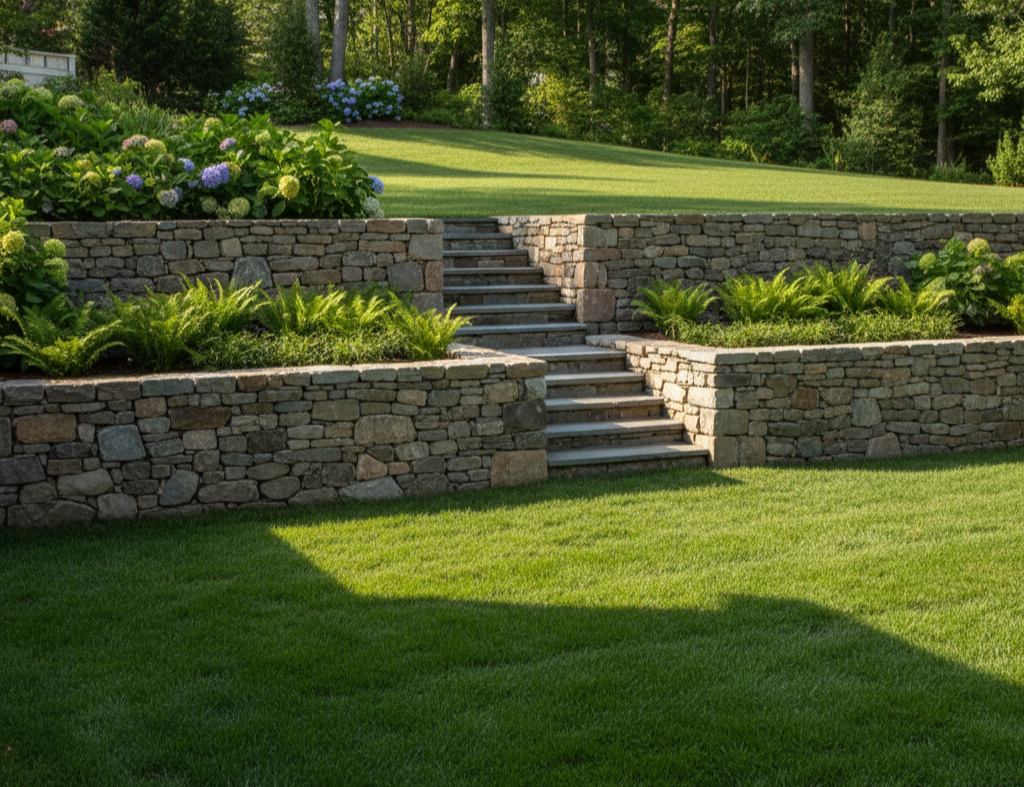
Bespoke Staircases for Washington, CT Estates
Excellence Masonry and Contracting designs and builds bespoke staircases for fine homes and estates in Washington, CT. Our commitment to quality materials and meticulous construction is second to none.
Masonry steps in Washington require total precision to handle daily use and winter ice on the region's varied elevations. We construct our stairs over reinforced concrete cores or deep aggregate foundations to handle the weight and provide permanent stability against frost-heave. By utilizing non-slip materials like Thermal Bluestone or textured granite, we create a secure transition between your property’s levels. Each tread is set with a slight pitch to ensure water runoff, which prevents ice buildup and protects the mortar joints from the moisture damage common in the Washington area.


Washington’s Preferred Choice For Professional Steps & Stairs
There are many construction, landscaping, outdoor living, and design companies to choose from- here is what makes us different.
-
Our Approach is Thorough and Integrated – As a design-build firm, we eliminate the gap between planning and execution, ensuring every project or service is assessed and delivered with maximum efficiency and zero oversights.
-
The Team We Have is Experienced and Robust – Backed by a 25-year family legacy and a crew with up to 50 years of expertise, our team of long-term employees and trusted partners provides a level of craftsmanship that only comes from decades in the field.
-
Industry-Leading Warranties and a Client for Life Guarantee – We provide warranties that far exceed state minimums. Our "Client for Life" commitment means we intend to stand by you, and our work, well beyond one project or its warranty. Our goal is to build a relationship, and become a trusted resource for you, year after year. We remain open to address issues, answer questions, assist with maintenance, or repairs, no matter what. Our business is relationship based, not transactional.
-
Transparency and Consistent Communication – We keep you in control through complete education and daily updates. From the first call to the final walkthrough, we ensure all costs, options, and timelines are fully transparent.
-
Commitment to Professional Responsibility and Top-Quality – We take full ownership of project or service management so you don't have to. Our focus is on delivering the highest feasible standard within your budget, supported by premium partners and a high-performance process.

Our Process | Our Technical Standards For Washington Steps & Stairs
Of course, every project, service and every situation is different, and so is our approach. Below is a general and simplified outline of our process. We can also bid and build to your preexisting plan or design.
1.
Discovery/Consultation
We engineer the rise and run for maximum safety and comfort. We value-engineer the foundation (frost-line depth) and specify a slight outward pitch for each tread to ensure water runoff and prevent winter ice accumulation.
2.
Design / Planning
We engineer the rise and run for maximum safety and comfort. We value-engineer the foundation (frost-line depth) and specify a slight outward pitch for each tread to ensure water runoff and prevent winter ice accumulation.
3.
Construction / Service
We engineer the rise and run for maximum safety and comfort. We value-engineer the foundation (frost-line depth) and specify a slight outward pitch for each tread to ensure water runoff and prevent winter ice accumulation.
What materials do you use to build masonry steps?
We build steps and stairs using a variety of long-lasting materials. Popular choices include natural stone like granite and bluestone, classic brick, and interlocking concrete pavers that can match your existing patio or walkway.
FAQ's
What is a 'tread' and a 'riser'?
In stair construction, the 'tread' is the horizontal part that you step on. The 'riser' is the vertical part that connects each tread. The ratio of riser height to tread depth is critical for making stairs comfortable and safe to walk on.
Do I need a permit to build or replace my front steps?
Yes, in almost all cases. Front steps are a primary means of egress from your home and are subject to strict building codes regarding height, width, railings, and landings. A permit and inspection are typically required to ensure safety compliance.
How do you make sure stone steps are safe and not slippery?
Safety is our top priority. We use materials with a natural, non-slip texture. For stone like bluestone, we recommend a 'thermal' finish, which has a slightly rough texture that provides excellent grip even when wet. We also ensure all steps are perfectly level and built to consistent heights.
Why is the foundation for outdoor stairs so important?
An outdoor staircase needs a solid concrete footing that extends below the frost line (42 inches in CT). This prevents the stairs from heaving upwards or sinking during the winter freeze-thaw cycles, which would create an unsafe and uneven walking surface.
4.
Walk-Thru, Clean-Up & Maintain
We engineer the rise and run for maximum safety and comfort. We value-engineer the foundation (frost-line depth) and specify a slight outward pitch for each tread to ensure water runoff and prevent winter ice accumulation.


Testimonials


What is a 'tread' and a 'riser'?
In stair construction, the 'tread' is the horizontal part that you step on. The 'riser' is the vertical part that connects each tread. The ratio of riser height to tread depth is critical for making stairs comfortable and safe to walk on.
Why is the foundation for outdoor stairs so important?
An outdoor staircase needs a solid concrete footing that extends below the frost line (42 inches in CT). This prevents the stairs from heaving upwards or sinking during the winter freeze-thaw cycles, which would create an unsafe and uneven walking surface.
Do I need a permit to build or replace my front steps?
Yes, in almost all cases. Front steps are a primary means of egress from your home and are subject to strict building codes regarding height, width, railings, and landings. A permit and inspection are typically required to ensure safety compliance.
How do you make sure stone steps are safe and not slippery?
Safety is our top priority. We use materials with a natural, non-slip texture. For stone like bluestone, we recommend a 'thermal' finish, which has a slightly rough texture that provides excellent grip even when wet. We also ensure all steps are perfectly level and built to consistent heights.
What materials do you use to build masonry steps?
We build steps and stairs using a variety of long-lasting materials. Popular choices include natural stone like granite and bluestone, classic brick, and interlocking concrete pavers that can match your existing patio or walkway.