%20(2).png)
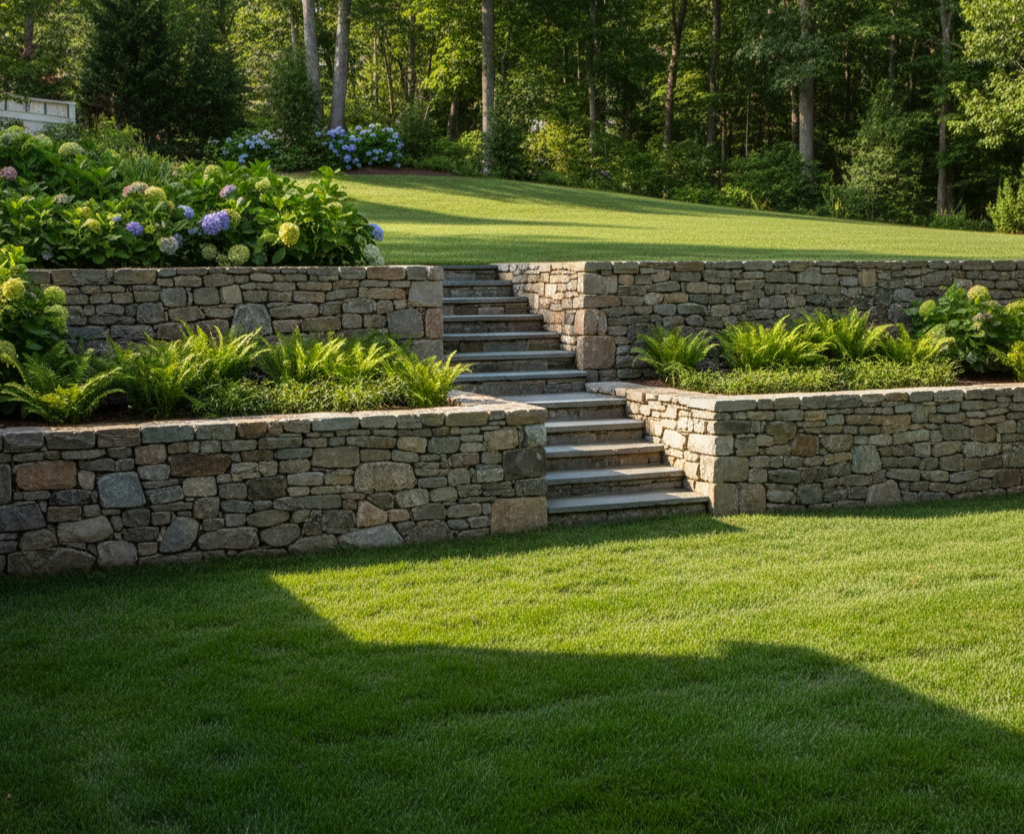
Custom Stone Wall Construction in Fairfield, CT
From retaining walls in the beach area to fieldstone walls in Greenfield Hill, we provide custom stone wall construction throughout Fairfield, CT. Excellence Masonry and Contracting tailors every project to the home.
A structurally sound stone wall is a masterful blend of physics and artistry. For dry-stacked walls, success depends on the careful selection and interlocking of stones, ensuring each one is placed with a minimum of three points of contact and is battered (leaned back) into the hillside for stability. For mortared walls, we focus on creating a deep, concrete footing and/or posts below the frost line to prevent heaving, and we incorporate "weep holes" to relieve the hydrostatic pressure that builds up behind the wall. These time-honored techniques ensure the walls we build are not just beautiful features but enduring structural elements of your landscape.


Why Choose Us?
There are many construction, landscaping, outdoor living, and design companies to choose from- here is what makes us different.
-
Our Approach is Thorough and Integrated – As a design-build firm, we eliminate the gap between planning and execution, ensuring every project or service is assessed and delivered with maximum efficiency and zero oversights.
-
The Team We Have is Experienced and Robust – Backed by a 25-year family legacy and a crew with up to 50 years of expertise, our team of long-term employees and trusted partners provides a level of craftsmanship that only comes from decades in the field.
-
Industry-Leading Warranties and a Client for Life Guarantee – We provide warranties that far exceed state minimums. Our "Client for Life" commitment means we intend to stand by you, and our work, well beyond one project or its warranty. Our goal is to build a relationship, and become a trusted resource for you, year after year. We remain open to address issues, answer questions, assist with maintenance, or repairs, no matter what. Our business is relationship based, not transactional.
-
Transparency and Consistent Communication – We keep you in control through complete education and daily updates. From the first call to the final walkthrough, we ensure all costs, options, and timelines are fully transparent.
-
Commitment to Professional Responsibility and Top-Quality – We take full ownership of project or service management so you don't have to. Our focus is on delivering the highest feasible standard within your budget, supported by premium partners and a high-performance process.

Our Process
Of course, every project, service and every situation is different, and so is our approach. Below is a general and simplified outline of our process. We can also bid and build to your preexisting plan or design.
1.
Discovery/Consultation
We evaluate the slope and structural needs of the site, discussing the aesthetic of native Connecticut fieldstone vs. dimensioned stone. We identify preliminary considerations like hydrostatic pressure and site access, providing a rough estimate or design agreement based on the wall's height and linear footage.
2.
Design / Planning
We engineer the wall for permanent site stability, focusing on internal drainage. This includes planning for 3/4-inch clean stone backfill, non-woven geotextile fabric, and a footing set below the 42-inch frost line. We establish the project pricing and a construction plan that manages elevations with total structural reliability.
3.
Construction / Service
Our masons build from the foundation up, employing traditional dry-stack or mortar-set techniques with architectural precision. We focus on the "invisible" drainage layers as much as the visible stone work. Expect a clean site and clear updates as we transform your landscape’s topography.
What's the difference between a dry-laid and a mortared stone wall?
A dry-laid (or dry-stack) wall is built without mortar, relying on the careful placement and friction of the stones for stability. A mortared wall uses cement mortar to bind the stones, creating a solid, unified structure often used for retaining walls or veneers.
FAQ's
What kind of stone is best for a wall in Connecticut?
Connecticut fieldstone is a classic and popular choice that gives a timeless, rustic look. Other great options include granite for its strength and durability, and various types of bluestone or flat stone for more formal, contemporary walls.
How long does it take to build a stone wall?
The timeline depends entirely on the wall's length, height, style (dry-laid vs. mortared), and site accessibility. A small decorative wall might take a few days, while a large, structural retaining wall could take a week or more.
Does a retaining wall need a permit?
Often, yes. Most towns in Connecticut require a building permit for retaining walls over a certain height (typically 3 to 4 feet). We always recommend verifying with your local building department before starting a retaining wall project.
How do you ensure a stone wall won't fall over?
The key is a proper foundation. Every wall we build starts with an excavated trench filled with a compacted gravel base below the frost line. For retaining walls, we also incorporate proper drainage systems to relieve hydrostatic pressure.
4.
Walk-Thru, Clean-Up & Maintain
We perform a final check on the wall’s plumb and the daylighting of the drainage system. We’ll walk you through the structural features and discuss maintenance—such as monitoring weep holes—confirming the wall is a permanent, sophisticated addition to your property’s site stewardship.


Testimonials


What kind of stone is best for a wall in Connecticut?
Connecticut fieldstone is a classic and popular choice that gives a timeless, rustic look. Other great options include granite for its strength and durability, and various types of bluestone or flat stone for more formal, contemporary walls.
How do you ensure a stone wall won't fall over?
The key is a proper foundation. Every wall we build starts with an excavated trench filled with a compacted gravel base below the frost line. For retaining walls, we also incorporate proper drainage systems to relieve hydrostatic pressure.
How long does it take to build a stone wall?
The timeline depends entirely on the wall's length, height, style (dry-laid vs. mortared), and site accessibility. A small decorative wall might take a few days, while a large, structural retaining wall could take a week or more.
Does a retaining wall need a permit?
Often, yes. Most towns in Connecticut require a building permit for retaining walls over a certain height (typically 3 to 4 feet). We always recommend verifying with your local building department before starting a retaining wall project.
What's the difference between a dry-laid and a mortared stone wall?
A dry-laid (or dry-stack) wall is built without mortar, relying on the careful placement and friction of the stones for stability. A mortared wall uses cement mortar to bind the stones, creating a solid, unified structure often used for retaining walls or veneers.